If you're wondering how to tell if a mirror is two-way, the fastest answer is the fingernail test — but it isn't foolproof on its own. Below are five quick checks you can run in under a minute, from the famous fingernail test to the more reliable flashlight method, plus what to do if a mirror fails.
You're in a hotel bathroom or an Airbnb bedroom and the mirror feels off. Maybe it's set flush into the wall instead of hung on it. Maybe it's bigger than the room needs. The thought creeps in: is someone on the other side?
Two-way mirrors — also called one-way mirrors, two-way glass, or sometimes a "double-sided mirror" — are genuinely rare in rentals. The names all describe the same thing: glass that shows a mirror on the brightly lit side and a window on the dark side. But they're unsettling enough, and the test is quick enough, that it's worth knowing how to check.
What a two-way mirror actually is
A two-way mirror is a sheet of glass with a very thin, partial reflective coating. When one side is brightly lit and the other is dark, the person on the bright side sees a mirror, while the person on the dark side sees through it like a window.
The key word is lighting. A two-way mirror only works as a spy device when the hidden side is darker than your side. That single fact is behind almost every test below.
How to tell if a mirror is two-way: 5 quick tests
No single test is perfect. Run two or three together and you'll have a confident answer.
Test 1 — The fingernail test
The famous one — sometimes called the gap test. Place a fingernail against the surface of the mirror and look at the gap between your real nail and its reflection.
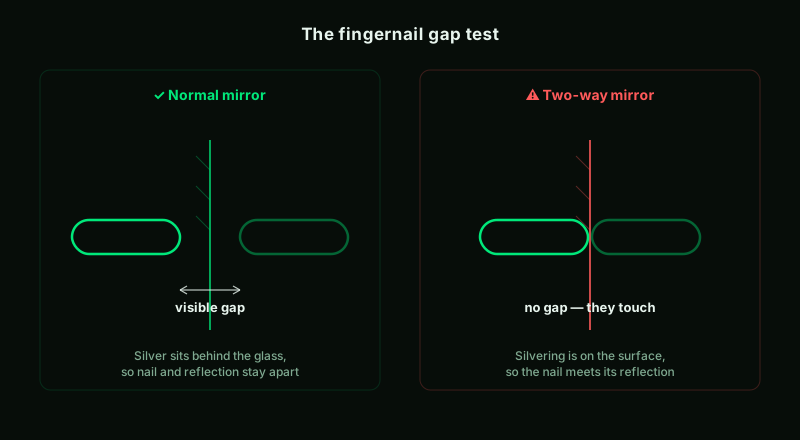
Normal mirror: there's a clear gap — the reflective coating is behind a layer of glass, so your nail can't reach it.
Two-way mirror: the nail seems to touch its reflection directly, because the coating is on the front surface.
Be honest about this one: the fingernail test is a useful first check, but lighting, thick glass and angle can fool it. If the result is ambiguous, don't stop here — move to the flashlight test, which is far more reliable.
Test 2 — The flashlight test in the dark
This is the most reliable check. Turn off every light in the room and let your eyes adjust. Then cup your hands around your eyes, press them to the glass, and shine a flashlight directly at the mirror.
Normal mirror: you see only darkness and your flashlight reflected back.
Two-way mirror: the light passes through and you can make out the room or cavity on the other side.
Because it attacks the one thing a two-way mirror depends on — the dark side being hidden — this test is hard to fool.
Test 3 — Check the room logic
Step back and think about where the mirror is and how it's mounted. A two-way mirror needs a darker space behind it, so watch for:
- A mirror set flush into the wall rather than hung on it with a gap behind.
- An unexplained closet, room, or dead space on the other side of that wall.
- A large mirror placed where it has a clear line of sight to the bed or shower.
None of these prove anything alone, but together they tell you whether the flashlight test is worth doing carefully.
Test 4 — The knock test
Gently tap a knuckle against the glass and listen.
Normal mirror: fixed against a solid wall, it sounds dull and flat.
Two-way mirror: with a room or cavity behind it, it tends to sound hollow and open.
It's the least precise test, but it's instant and needs nothing but your hand.
Test 5 — Check for the camera itself
Here's the part most "two-way mirror" guides miss: the bigger risk usually isn't a person behind the glass — it's a tiny camera placed behind, beside, or drilled into the mirror.
With the room lights off, sweep your phone flashlight slowly across the glass and the frame, watching for a bright lens glint. Then run a WiFi and Bluetooth scan to catch any networked camera nearby. A two-way mirror is rare; a hidden camera near a mirror is the more realistic threat.
Bluewex runs the WiFi, Bluetooth and magnetic scans plus the lens-glint check in one tap. Download free →
For the full room-by-room method, see our full guide on how to detect hidden cameras: 10 ways that actually work.
When should you actually worry?
Rarely. True two-way mirrors in hotels and short-term rentals are uncommon — far more reports involve a small camera hidden in an everyday object than an actual one-way mirror. The vast majority of mirrors are exactly what they look like.
But the checks above take under a minute combined, and the downside of being wrong is serious enough that a quick test on arrival is reasonable — especially for a mirror that faces the bed.
If you want a single arrival routine that covers mirrors, cameras and more, see our Airbnb safety scan.
What to do if a mirror fails the test
Stay calm and don't tip off anyone who might be watching.
- Don't undress or discuss anything private near the mirror.
- Document it — photo and video of the mirror, its mounting, and your test result.
- Cover it temporarily with a towel or a piece of furniture if you're staying.
- Report it. For an Airbnb, contact Airbnb support directly rather than the host. For a hotel, escalate to management and consider a police report.
- Leave if you feel unsafe. Your safety outweighs the cost of the booking.
Hidden surveillance in private spaces is illegal in most US states and EU countries.
Frequently asked questions
Is the fingernail test for a two-way mirror reliable?
It's a useful first check but not foolproof. Glass thickness, lighting and viewing angle can all make the gap hard to judge. Pair it with the flashlight-in-the-dark test, which is much more reliable because it targets the one thing a two-way mirror depends on.
Are two-way mirrors common in hotels and Airbnbs?
Genuinely rare. Far more common is a small camera hidden in or near an ordinary object — a smoke detector, clock, or the mirror frame itself. The check is still worth doing because it only takes a minute.
How does the flashlight test work on a two-way mirror?
In a dark room, a two-way mirror is partially transparent. Cupping your hands around your eyes and shining a flashlight at the glass lets you see the darker space behind it, while a normal mirror simply reflects the light back.
Can there be a camera behind a normal mirror?
Yes. A camera can sit behind a small drilled hole or beside the frame even on a standard mirror, with no two-way glass involved. Do a lens-glint flashlight sweep and a WiFi and Bluetooth scan to be sure.
What should I do if a mirror fails the test?
Don't undress or discuss anything private near it, document it with photo and video, cover it, and report it — to Airbnb support or hotel management, and to police if you believe someone is watching. Leave if you feel unsafe.
Is a one-way mirror the same as a two-way mirror?
Yes. "One-way mirror," "two-way mirror," "two-way glass" and "2-way mirror" are all names for the same partially reflective glass — it looks like a mirror from the brightly lit side and like a window from the darker side. A "double-sided mirror" sometimes means the same thing when people are worried about being watched, though the term can also just mean an ordinary vanity mirror with glass on both faces.
How do I do the 2-way mirror finger test?
Press a fingernail flat against the glass and look at the gap between your nail and its reflection. A clear gap means a normal mirror (the silvering sits behind the glass); no gap — your nail seems to touch its reflection — points to a two-way mirror. It's a quick first check, so confirm anything suspicious with the flashlight-in-the-dark test.
The bottom line
Most mirrors are just mirrors. But if one feels off, you don't need any equipment to check: the fingernail test, a flashlight in the dark, the room logic, a knock, and a quick scan for a camera will settle it in under a minute.
If you want help with the camera scan, that's exactly what Bluewex does — free on iOS and Android.
Travel safe.
Related guides: How to Detect Hidden Cameras: 10 Ways · Bluewex Hidden Camera Detector · Full Airbnb Safety Scan